


Tampa vs Orlando vs Miami for Distribution
How to choose the right Florida distribution hub for your business
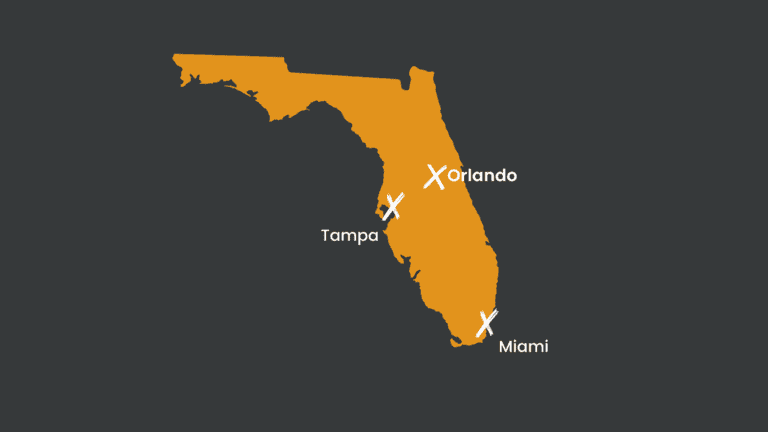
If you’re a manufacturer, importer, or distributor moving 20 to 300 pallets at a time, choosing the right city in Florida is not just a geography decision. It’s a cost, speed, and operational decision.
We regularly see companies choose the wrong location, only to deal with higher freight costs, longer transit times, or operational friction later.
This guide breaks down Tampa vs Orlando vs Miami for distribution, based on how freight actually moves, where customers are located, and how warehouses operate in each market.
The 3 Factors That Actually Matter
Before comparing cities, focus on what really drives your distribution success:
- Inbound Freight Costs
Where does your product come from, and how expensive is it to get into each city? - Customer Location
Where are your customers actually located and where does the freight need to ship to once sold? - Warehouse Operations & Availability
Can the warehouse handle your freight efficiently (dock height, pallet handling, turnaround time)?
Most companies overweight “central location” and underweight total landed cost. That’s where mistakes happen.
Tampa for Distribution
Where Tampa Wins
Tampa is one of the most practical distribution hubs in Florida, especially for companies that want balance between inbound freight costs and regional delivery.
Key advantages:
- Direct access to Port Tampa Bay for ocean container unloading and distribution
- Rail access for inbound freight
- Lower overall costs compared to Miami
- Strong proximity to customers across Central Florida
- Growing number of warehouse options (more opening in recent years)
A large portion of companies using Tampa fall into two categories:
- Importers bringing freight directly into Tampa via container or rail
- Distributors whose customers are within ~1 hour of Tampa
This second group is more common than most expect. Many Florida distribution networks are more localized than national maps suggest.
Operational Fit in Tampa Warehouses
Most Tampa distribution warehouses are built for:
- Dock-high loading for dry vans, box trucks, and ocean containers
- Handling 40×48 GMA pallets (Grade A or B), with flexibility for CHEP or custom pallets
- Receiving:
- Floor-loaded containers (loose freight)
- Palletized truckloads
- Outbound:
- Full pallet shipments
- Mixed pallet builds
- Case picking (depending on operation)
You’ll typically see:
- Forklifts in the 5,000–8,000 lb range
- Ability to unload containers in 2–3 hours if properly staffed
- Flexible handling for restacks, transloads, and short-term storage
When Tampa Makes the Most Sense
Tampa is a strong choice if:
- Your freight comes through Tampa or nearby Gulf ports
- Your customers are concentrated in Tampa, Central Florida, or nearby regions
- You want to control inbound costs without sacrificing delivery speed
- You value flexibility (short-term projects, transloads, restacks)
Orlando for Distribution
Where Orlando Wins
Orlando is often considered the “central” location in Florida, and in some cases, that’s true.
Key advantages:
- Central positioning within the state
- High population density and consumption volume
- Strong air freight access via Orlando International Airport
The Reality of Orlando Distribution
Despite being central, Orlando has a major limitation:
No direct seaport access.
That means:
- Ocean containers must first go to Miami, Tampa, Jacksonville, or Savannah
- Then get trucked into Orlando
This adds:
- Additional drayage costs
- Extra handling steps
- More potential delays
Also, many warehouses that serve “Orlando” are actually located in:
- Lakeland
- Plant City
- Surrounding Central Florida industrial corridors
So even if you say “Orlando,” your freight may not physically be stored there.
When Orlando Makes Sense
Orlando can be a good fit if:
- Your customers are heavily concentrated in Central Florida or along the east side of the state
- You are less sensitive to inbound freight costs
- You rely more on air freight than ocean containers
We’ve seen companies move out of Tampa into Orlando when:
Their customer base shifted further east or deeper into Central Florida.
Miami for Distribution
Where Miami Wins
Miami is the most established logistics hub in Florida, especially for international trade.
Key advantages:
- Highest volume of inbound vessels in Florida
- Strong trade lanes with South America and Central America
- Largest concentration of warehouse options
- Mature logistics ecosystem
If your supply chain is heavily international, Miami is often the default entry point.
The Tradeoff: Cost
Miami is typically the most expensive of the three markets.
You’ll often see:
- Higher warehouse rates
- Higher labor costs
- More congestion
- Longer truck turn times
For some businesses, this is worth it. For others, it quietly erodes margins.
When Miami Makes the Most Sense
Miami is the right choice if:
- Your freight is heavily tied to international imports, especially from Latin America
- You need access to high-volume, established logistics infrastructure
- You benefit from being close to the port of entry
Total Cost Comparison (What Most Companies Miss)
The biggest mistake we see is evaluating cities based on warehouse rent or storage cost alone.
Instead, evaluate:
1. Inbound Freight
- Ocean container to Miami vs Tampa vs inland to Orlando
- Rail vs truck costs
2. Warehouse Handling
- Pallet in / pallet out
- Case picking or pallet building
- Storage (stackable vs non-stackable pallets)
3. Outbound Freight
- Distance to customers
- LTL vs full truckload costs
- Delivery frequency
Example Insight
A company might assume:
“Orlando is central, so it’s cheapest overall.”
But in reality:
- Higher inbound freight to Orlando
- Similar or slightly lower outbound costs
- Net result = higher total cost
This is why total landed cost matters more than geography alone.
Should You Use One Location or Multiple?
In some cases, the best answer isn’t Tampa vs Orlando vs Miami.
It’s:
Tampa + Orlando
or
Miami + Tampa
Multi-location distribution can make sense when:
- You have distinct customer clusters
- Delivery speed is critical
- Freight volumes justify the added complexity
But for many companies in the 20 to 300 pallet range, a single well-selected location is more efficient.
Who Does Not Need a Florida Distribution Partner
If you are:
- A smaller eCommerce seller shipping a few orders per day
- Primarily doing parcel shipments (UPS/FedEx only)
- Storing less than ~10–15 pallets
This type of distribution strategy likely does not apply to you.
You are likely better served by:
- Fulfillment centers
- Parcel-focused 3PL providers
This guide is specifically for companies moving pallets and cases at scale, not individual pieces.
How to Choose the Right City - A Simple Framework
Ask yourself:
- Where does my product enter Florida?
- Where are my customers actually located?
- What is my true total landed cost in each city?
Then:
- If inbound cost matters most → lean Tampa or Miami
- If customer location dominates → lean Orlando or Tampa
- If international volume is high → lean Miami
Final Takeaways
- Tampa = balanced cost, growing hub, strong for regional distribution
- Orlando = central location, but higher inbound costs
- Miami = international powerhouse, but most expensive
There is no universal “best” city, only the best fit for your operation.
Get Help Choosing the Florida Distribution Location
If you’re evaluating Florida distribution and want real numbers, not guesses, we can help.
We work with companies that:
- Store 20 to 300+ pallets
- Receive containers or truckloads
- Ship pallets or cases to retailers, distributors, and other buyers
We’ll help you evaluate Tampa options for:
- Inbound costs
- Storage and handling
- Outbound distribution fit


